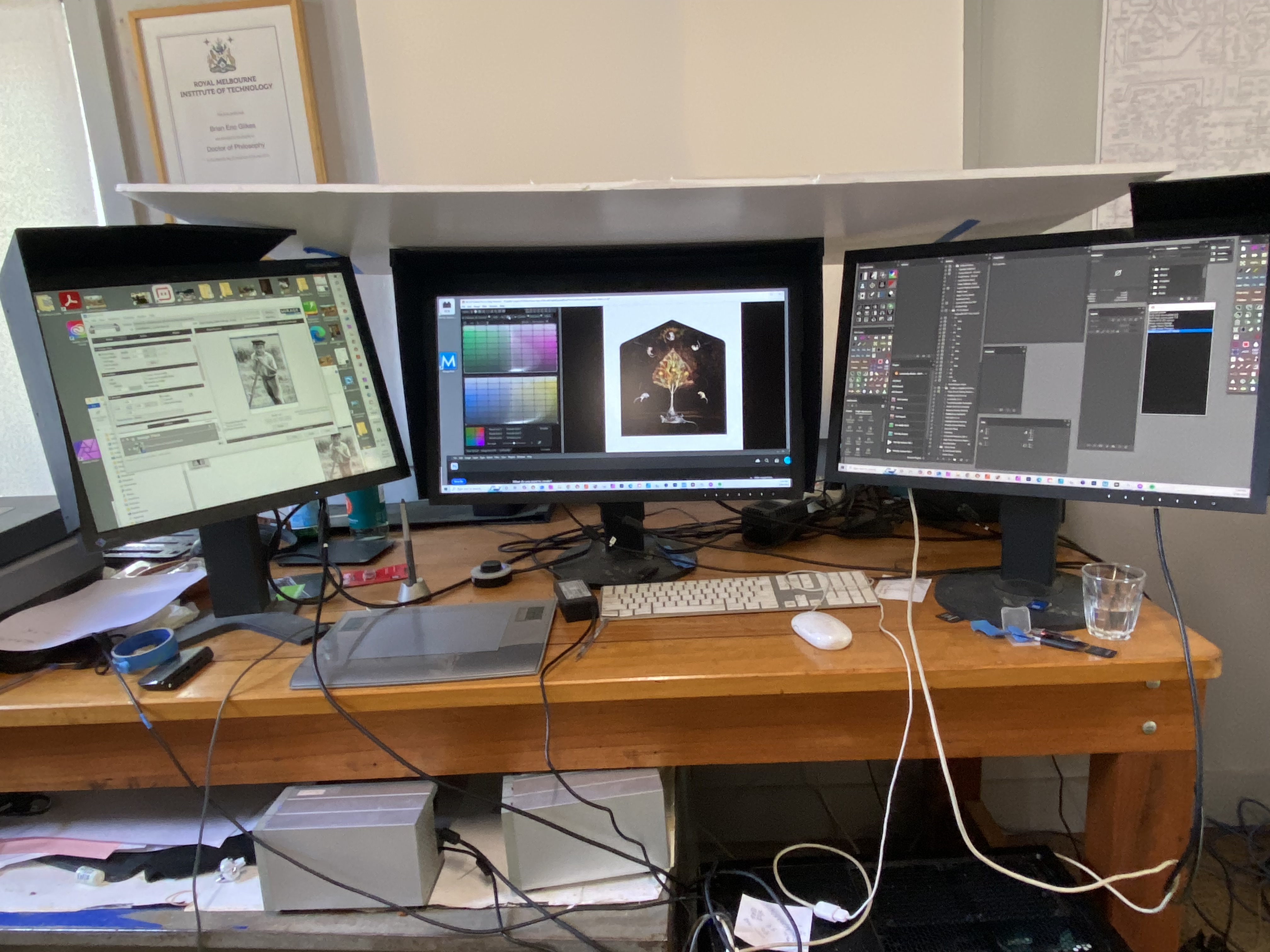
In collaboration with master Printer Dr Brian Gilkes the studio edits digital image files to produce prints of outstanding presence and archival qualities.
The editing process first evaluates the file for any problems which can be corrected.
The project is discussed in depth with the artist . This process will suggest editing directions and possibilities.
A typical workflow for a colour image would initially seperate the tonal information from the colour data. Usually this is done in non RGB spaces where tones are extracted that match the human visual process thus optimising luminosity , making the image more “real”. The tones representing original colours may be modified so adjacent colours are on seperate tones. This is a strategy used by the great painters of the Renaissance and the following Dutch Masters.
The colours can then be edited first for neutrality as a base to work from , and then to create visual depth and mood
Significant stages of the editing process may be proofed and , when stable, closely examined ad discussed to confirm or modify direction.
Finally any artefacts (dust etc) are removed and the image is sharpened (if required) , sized (using advanced interpolation software ) , de-noised (often now using AI noise detection) and printed.
Printing uses 9 or 10 pigment inks on Epson printers adjusted for optimum quality. In practice this means slowest speed, single head pass and up to date custom profiles.
Contact
pharoseditions@bigpond.com
 The Pharos Centre